Navaratna
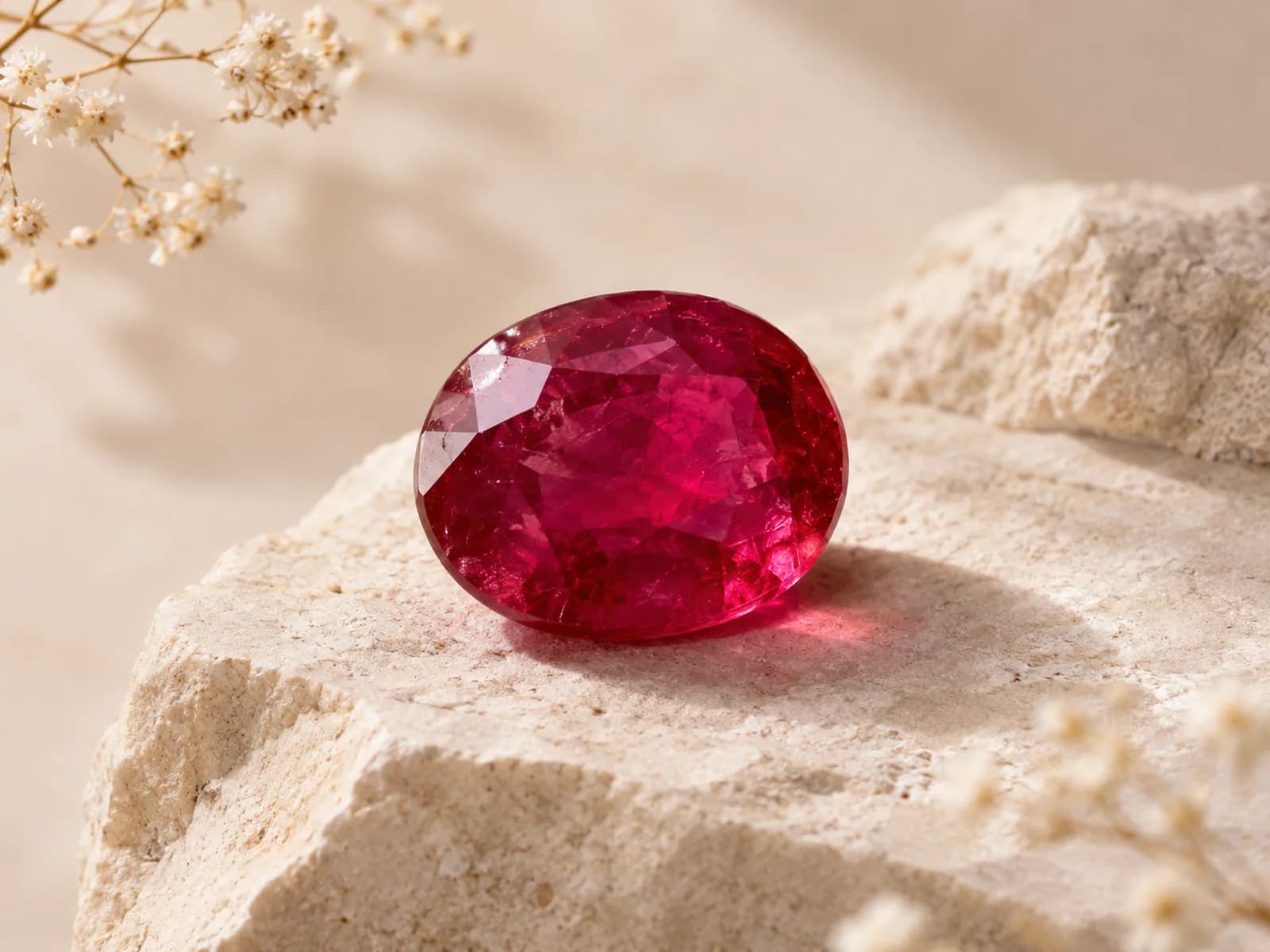
Ruby (Manik Stone)
The deep-red stone of the Sun — passion, vitality and protection.
No ruby currently listed. Stones arrive in small batches — call or write and we will tell you what is available.
Buy Ruby online
Enquire about Ruby
This stone is sourced to order in most weights. Tell us the carat or ratti you need and the purpose, and we will send what is available with certificates and photos before you commit.
Send an enquiryWhat Ruby is
Ruby's chromium atoms absorb yellow-green light and emit intense red fluorescence. In Vedic astrology this concentrated red-spectrum transmission mirrors the life-giving solar radiation of Surya — the Atmakaraka, significator of the soul, vitality, father and authority. Wearing an unheated Manik is traditionally understood as a solar prism, channelling vital Prana into the wearer's aura.
Properties
- Mineral family
- Corundum (Al₂O₃ with trace chromium)
- Hardness
- 9.0 Mohs — second only to diamond
- Refractive index
- 1.762 – 1.770
- Specific gravity
- 3.97 – 4.05
- Colour
- Pinkish-red to deep pigeon-blood crimson
- Key origins
- Burma/Myanmar (finest), Mozambique, Madagascar, Thailand
- Buying standard
- Natural, unheated, untreated with visible silk/rutile inclusions
How to wear Ruby
- Weight
- 3 to 6 ratti (1 ratti per 12 kg body weight)
- Metal
- Gold or copper, open-back setting
- Finger
- Ring finger (Anamika), working hand
- Day
- Sunday morning, Shukla Paksha
- Mantra
- Om Hram Hreem Hroum Sah Suryaya Namah (108 times)
Wearing method follows tradition. It is guidance, not a promise of any outcome — see our approach to describing stones.
Who should wear Ruby
Tradition associates Ruby primarily with Simha (Leo), and beneficially with Mesh (Aries), Kark (Cancer), Vrishchik (Scorpio) and Dhanu (Sagittarius).
Who should not wear it
Tradition advises against Ruby for Tula (Libra), Makar (Capricorn) and Kumbh (Aquarius). This is the section most sellers leave out. If you are unsure which rashi applies to you, our reading tool calculates it from your birth details rather than asking you to guess.
What determines the price
Price is not one number. Four things move it, and they move it a lot:
- Treatment. An untreated stone with no indications of heating can cost several times an otherwise identical heated stone. Every listing states its treatment, and the certificate records it.
- Origin. A stone from a classic source (Burma for ruby, Kashmir for blue sapphire, Ceylon for yellow sapphire) carries a premium that is real but can be overstated. The certificate names the origin only when the laboratory is confident.
- Colour and clarity. Saturation and tone first, then eye-visible inclusions. A stone with fine colour and a visible inclusion usually beats a clean stone with flat colour.
- Weight. Price per carat rises steeply with size, so a 4 ct stone costs more than twice a 2 ct stone of the same quality.
Live prices for what is currently available are shown above — we do not publish a per-carat rate, because quoting one would be wrong for most stones.
Worth knowing
Rarer Than Diamonds
Fine, unheated Burmese rubies above 3 carats are significantly rarer in nature than colourless diamonds of the same size.
Glows Like Burning Coal
Sanskrit texts call ruby Ratnaraj — 'King of Gems' — and Angaraka, because its natural chromium fluorescence makes it appear to glow like a live ember in sunlight.
Laser Technology Pioneer
In 1960 the world's first working laser was built using a synthetic ruby crystal, proving its extraordinary capacity to focus light energy.
Common questions
- Is a treated ruby worth buying?
- Yes — heat-treated ruby is normal, durable and far more affordable. The key is disclosure: a reputable seller states exactly what treatment a stone has had. Avoid undisclosed glass-filled stones for everyday wear.
- How can I tell a real ruby from a fake?
- You cannot reliably do it by eye. Ask for a certificate from a recognised laboratory that states natural origin and treatment. Glass, garnet and synthetic corundum are all convincing imitations.
- What is the best ruby for astrology?
- Traditionally an untreated or heat-only ruby with strong colour, good clarity and no glass filling. We state treatment and origin on every product page so you can choose with confidence.