Navaratna
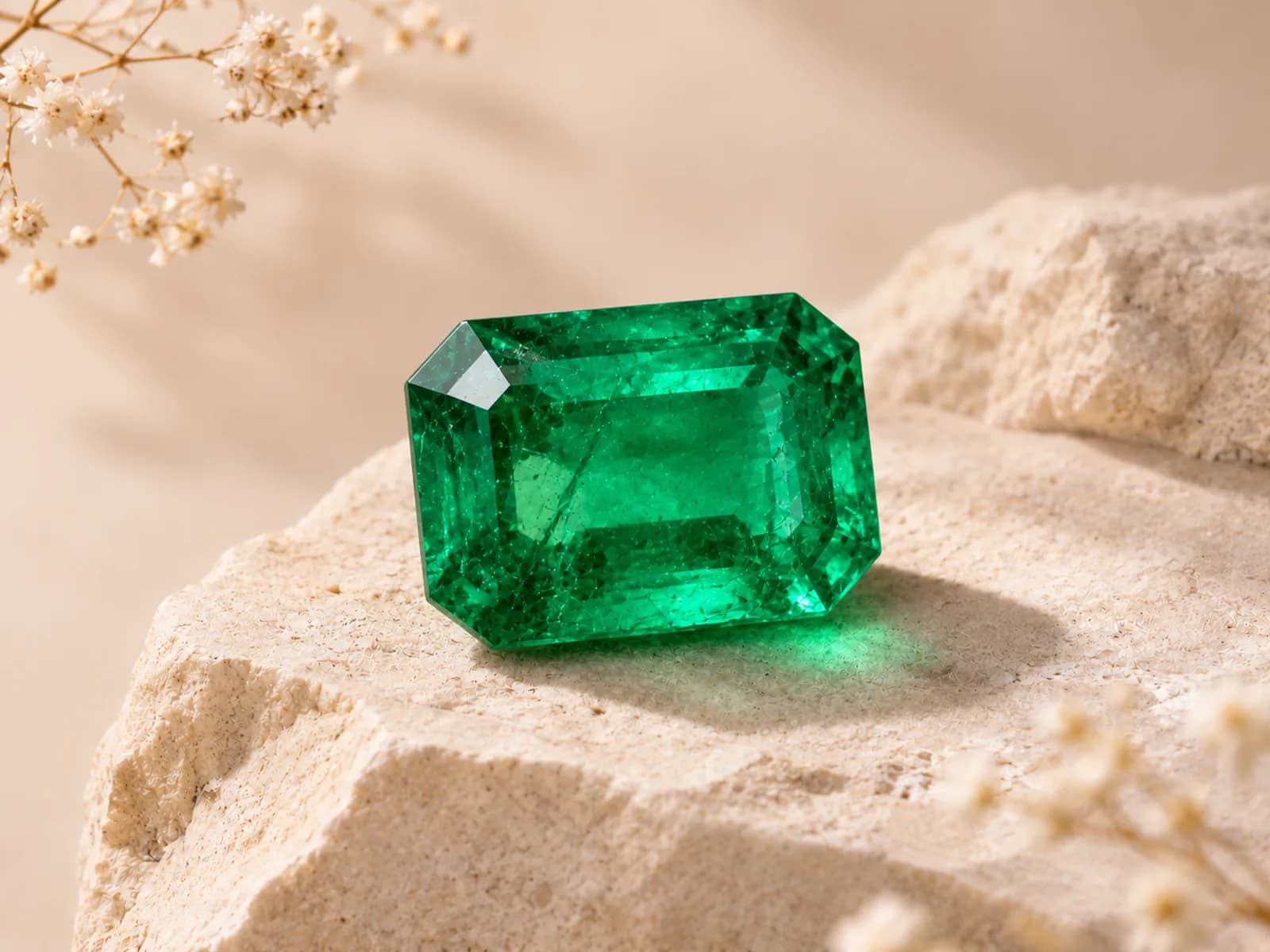
Emerald (Panna Stone)
The velvety green stone of Mercury — intellect, speech and commerce.
No emerald currently listed. Stones arrive in small batches — call or write and we will tell you what is available.
Buy Emerald online
Enquire about Emerald
This stone is sourced to order in most weights. Tell us the carat or ratti you need and the purpose, and we will send what is available with certificates and photos before you commit.
Send an enquiryWhat Emerald is
Emerald's soothing green wavelength sits at the centre of the visible spectrum, calming optic nerves and supporting cognitive focus. In Vedic astrology Panna channels Budh — Mercury — the planet of intellect (Buddhi), speech (Vaani), analytical commerce, mathematics and nervous-system coordination.
Properties
- Mineral family
- Beryl (Be₃Al₂(SiO₃)₆), coloured by chromium and vanadium
- Hardness
- 7.5 – 8.0 Mohs — brittle due to natural fractures (jardin)
- Refractive index
- 1.577 – 1.583
- Specific gravity
- 2.72
- Colour
- Lush velvety green to bluish-green
- Key origins
- Colombia (Muzo/Chivor), Zambia, Brazil, Swat Valley
- Buying standard
- Minor cedarwood-oil enhancement accepted; avoid polymer/resin-filled stones
How to wear Emerald
- Weight
- 3 to 6 ratti
- Metal
- Gold or silver, open-back ring or pendant
- Finger
- Little finger (Kanishthika), right hand
- Day
- Wednesday morning
- Mantra
- Om Bram Breem Broum Sah Budhaya Namah (108 times)
Wearing method follows tradition. It is guidance, not a promise of any outcome — see our approach to describing stones.
Who should wear Emerald
Tradition associates Emerald primarily with Mithun (Gemini) and Kanya (Virgo), and beneficially with Vrishabh (Taurus), Tula (Libra), Makar (Capricorn) and Kumbh (Aquarius).
Who should not wear it
Tradition advises against Emerald for Mesh (Aries), Kark (Cancer) and Vrishchik (Scorpio). This is the section most sellers leave out. If you are unsure which rashi applies to you, our reading tool calculates it from your birth details rather than asking you to guess.
What determines the price
Price is not one number. Four things move it, and they move it a lot:
- Treatment. An untreated stone with no indications of heating can cost several times an otherwise identical heated stone. Every listing states its treatment, and the certificate records it.
- Origin. A stone from a classic source (Burma for ruby, Kashmir for blue sapphire, Ceylon for yellow sapphire) carries a premium that is real but can be overstated. The certificate names the origin only when the laboratory is confident.
- Colour and clarity. Saturation and tone first, then eye-visible inclusions. A stone with fine colour and a visible inclusion usually beats a clean stone with flat colour.
- Weight. Price per carat rises steeply with size, so a 4 ct stone costs more than twice a 2 ct stone of the same quality.
Live prices for what is currently available are shown above — we do not publish a per-carat rate, because quoting one would be wrong for most stones.
Worth knowing
The Secret Garden Inside
Almost every natural emerald contains tiny internal inclusions called jardin (French for 'garden') — celebrated by gemologists as proof of authenticity.
Older Than Dinosaurs
Some of the oldest emeralds mined in South Africa and India crystallised nearly 2.97 billion years ago, making them among Earth's oldest gems.
20x Rarer Than Diamonds
High-clarity, unenhanced emeralds are roughly 20 times rarer per carat than colourless diamonds.
Common questions
- Are inclusions bad in an emerald?
- No — jardin is normal and expected. What matters is whether inclusions reach the surface or reduce transparency too much. Eye-clean emeralds are rare and priced accordingly.
- Is an oiled emerald acceptable?
- Yes, oiling is standard practice. Ask what was used and how heavily. Stable cedar-oil treatment is far preferable to resin filling.
- Can I wear an emerald ring every day?
- Yes, with care. Emerald is softer than sapphire and should be set in a protective bezel or halo. Avoid ultrasonic cleaners and sudden temperature changes.