Navaratna
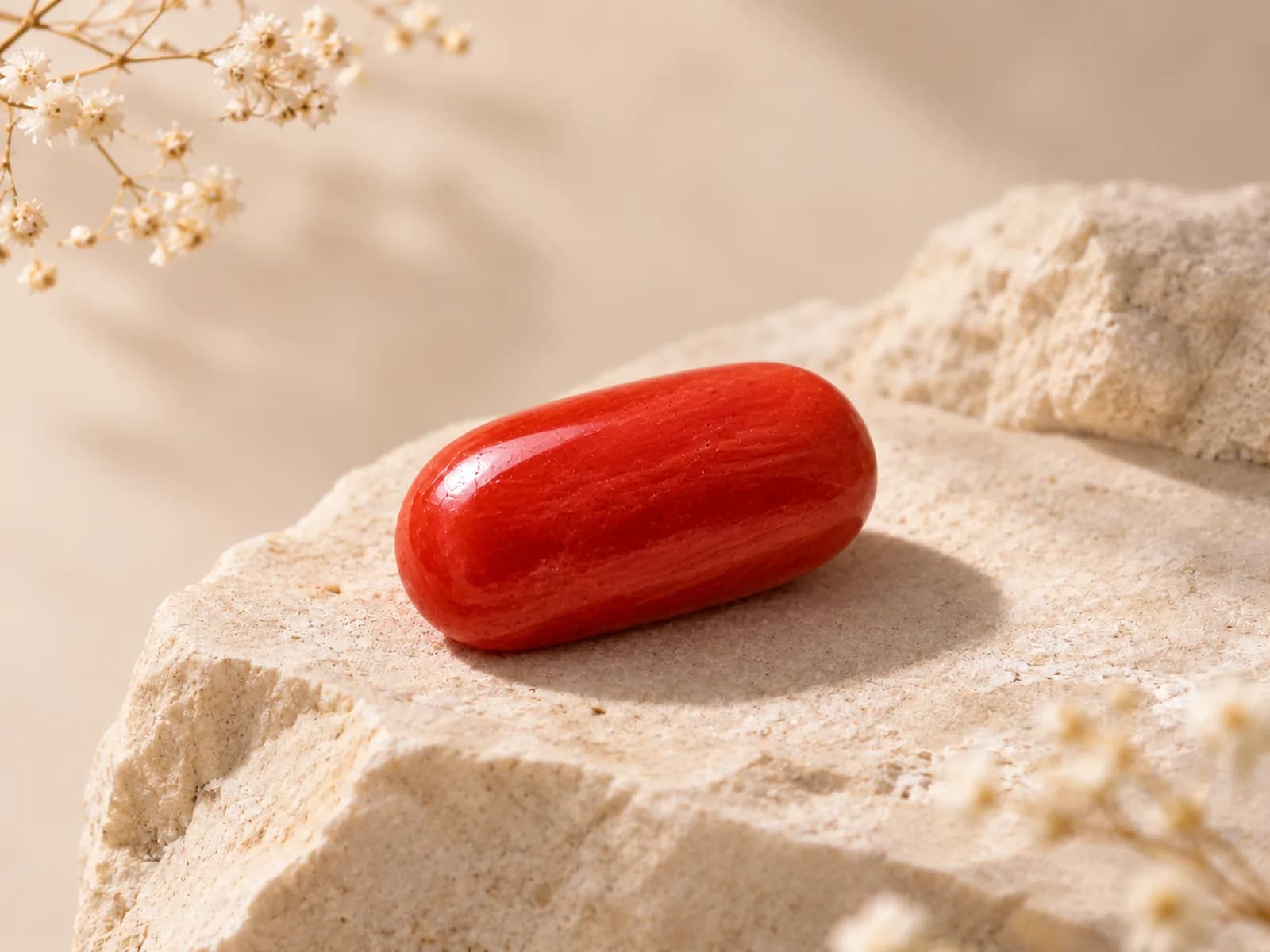
Red Coral (Moonga Stone)
The vermilion stone of Mars — courage, stamina and decisive action.
No red coral currently listed. Stones arrive in small batches — call or write and we will tell you what is available.
Buy Red Coral online
Enquire about Red Coral
This stone is sourced to order in most weights. Tell us the carat or ratti you need and the purpose, and we will send what is available with certificates and photos before you commit.
Send an enquiryWhat Red Coral is
Born from vibrant marine colonies thriving against deep ocean currents, red coral embodies raw biological resilience and fiery kinetic energy. In Jyotish, Moonga is the stone of Mangal — Mars — the celestial commander (Senapati), governing courage, physical strength, blood circulation, landed property and decisive action.
Properties
- Composition
- Organic calcium carbonate skeleton (Corallium rubrum), carotenoid pigment
- Hardness
- 3.5 – 4.0 Mohs
- Refractive index
- 1.486 – 1.658
- Specific gravity
- 2.60 – 2.70
- Colour
- Deep vermilion red, scarlet, orange-red (Sindoori)
- Key origins
- Mediterranean (Italian/Spanish), Japan, Taiwan
- Buying standard
- Undyed natural Italian or Japanese coral with wood-grain striations, no resin fill
How to wear Red Coral
- Weight
- 6 to 9 ratti
- Metal
- Gold or copper, open-back ring
- Finger
- Ring finger (Anamika)
- Day
- Tuesday morning, within one hour of sunrise
- Mantra
- Om Kram Kreem Kroum Sah Bhaumaya Namah (108 times)
Wearing method follows tradition. It is guidance, not a promise of any outcome — see our approach to describing stones.
Who should wear Red Coral
Tradition associates Red Coral primarily with Mesh (Aries) and Vrishchik (Scorpio), and beneficially with Kark (Cancer), Simha (Leo), Dhanu (Sagittarius) and Meen (Pisces).
Who should not wear it
Tradition advises against Red Coral for Mithun (Gemini) and Kanya (Virgo). This is the section most sellers leave out. If you are unsure which rashi applies to you, our reading tool calculates it from your birth details rather than asking you to guess.
What determines the price
Price is not one number. Four things move it, and they move it a lot:
- Treatment. An untreated stone with no indications of heating can cost several times an otherwise identical heated stone. Every listing states its treatment, and the certificate records it.
- Origin. A stone from a classic source (Burma for ruby, Kashmir for blue sapphire, Ceylon for yellow sapphire) carries a premium that is real but can be overstated. The certificate names the origin only when the laboratory is confident.
- Colour and clarity. Saturation and tone first, then eye-visible inclusions. A stone with fine colour and a visible inclusion usually beats a clean stone with flat colour.
- Weight. Price per carat rises steeply with size, so a 4 ct stone costs more than twice a 2 ct stone of the same quality.
Live prices for what is currently available are shown above — we do not publish a per-carat rate, because quoting one would be wrong for most stones.
Worth knowing
Deep-Sea Architecture
Gem-quality red coral is not a rock — it is the dense, stone-hard calcium skeleton built over centuries by tiny marine polyps in dark ocean depths.
Slowest-Growing Treasure
Precious Mediterranean Corallium rubrum grows only about 1 millimetre per year, so a sizeable Moonga branch takes decades to form.
Roman Talisman for Children
Ancient Romans hung red coral branches around children's necks to protect them from harm — a tradition echoed across rural India today.
Common questions
- Is red coral a stone or an animal?
- It is the skeleton of a marine organism — organic in origin, like pearl. This is why it is softer and more delicate than mineral gemstones.
- Can red coral get wet?
- Brief contact is fine, but do not soak it, wear it in the shower, or expose it to hot water and soap. Wipe with a dry soft cloth.
- What red is most valuable?
- A deep, uniform ox-blood red with no banding or white patches, typically of Italian origin.